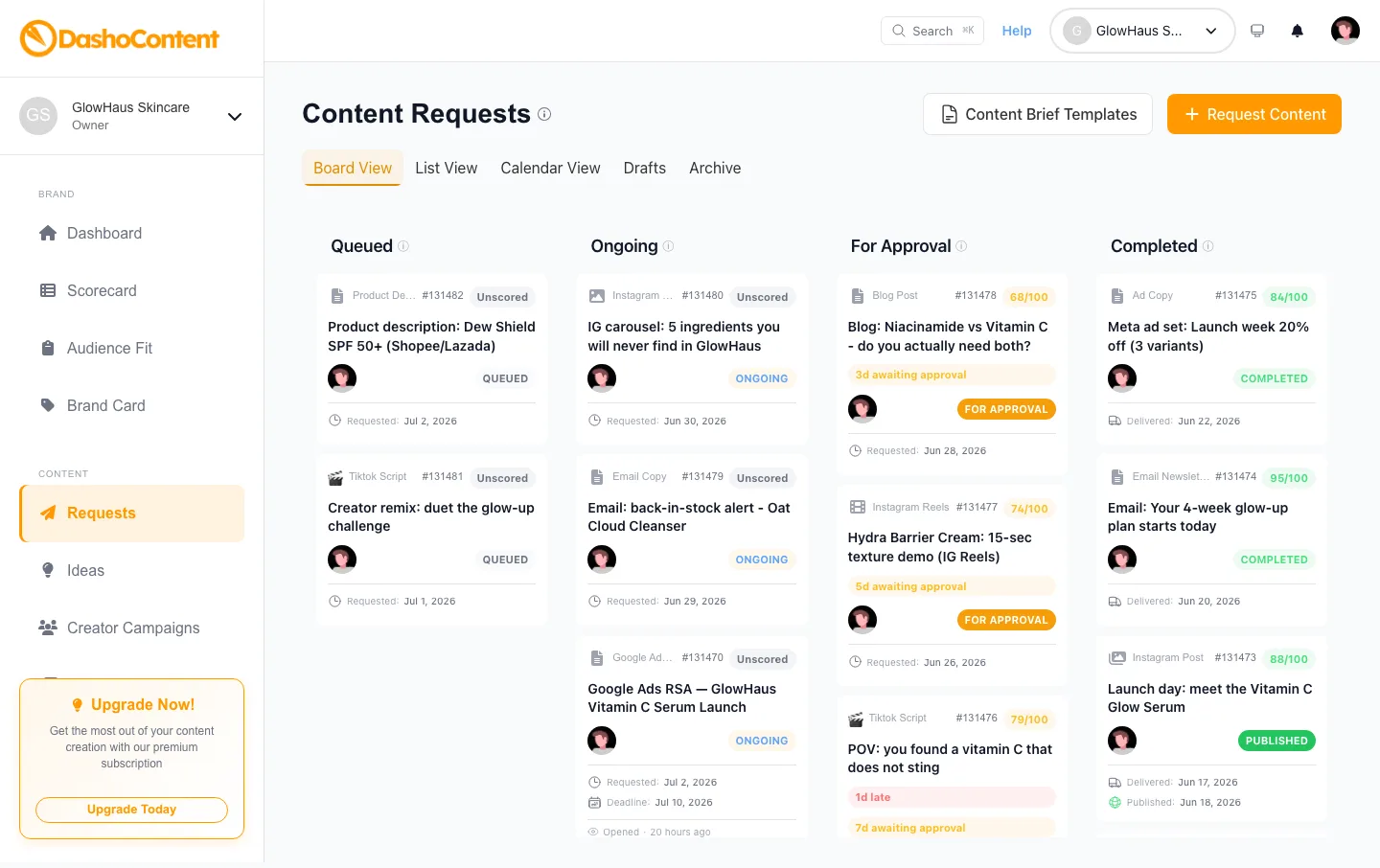
Mission Control for Modern Marketers
White-Label Contentrefers to professionally produced written, visual, or multimedia content created by a third-party vendor — then delivered to the client for publishing under their own brand. The creator receives no public credit. From the audience’s perspective, the content originates entirely from the brand itself.[1][2]
The significance of white-label content lies in its ability to separate content creation from content strategy. A brand can own the editorial direction, voice, and publishing cadence — while outsourcing production to a vetted vendor configured to match brand standards. This allows marketing teams to scale output without scaling headcount.brand-safe production model — one where Brief → Draft → Review → Publish cycles repeat reliably, regardless of topic volume. For agencies managing multiple clients, white-label content is a margin lever: it lets them serve clients at scale without building out dedicated writing teams for each account.[3][2]
Despite its advantages, white-label content requires careful vendor selection and onboarding. Poor brand voice calibration, generic output, or misaligned topic expertise results in content that fails editorial review or damages brand credibility. The risk is not in the model — it’s in choosing the wrong partner or skipping the configuration process entirely.[4][5]
As content velocity requirements increase across all marketing channels, white-label content is becoming a standard operational lever — not just for agencies, but for in-house marketing teams and enterprise content departments managing high publication volumes with lean staff.[6][7]
The Three Delivery Models
White-label content is typically delivered through one of three primaryproduction and delivery models: each with different levels of client involvement, turnaround speed, and output volume.
Content-as-a-Service: A subscription-based model where the vendor delivers a fixed volume of content per month under a documented brief and voice calibration. The client submits topics and approves drafts — the vendor handles research, writing, and formatting.[1].
Ghostwritten Editorial: Long-form articles, thought leadership posts, and bylined content written by the vendor and published under the client’s name or an internal team member’s byline. Common for executive LinkedIn content, industry publications, and blog series where the client’s voice needs to be prominent but internal bandwidth is limited.[1].
AI-Assisted Production: A hybrid model where AI handles first-draft generation — brief creation, structure, SEO formatting — while human editors review for brand voice, accuracy, and quality before delivery. Produces higher output volume at lower cost per asset while maintaining editorial standards.[3].
Consistent Brand Voice Across Volume
Brand consistency is the primary quality challenge in white-label content. When production is distributed across vendors, writers, and content types, voice drift and stylistic inconsistency are common failure modes. The best white-label operations use a documented Voice Card: a brief that captures tone, banned phrases, preferred sentence structure, formatting rules, and platform-specific style adjustments. Every brief references the Voice Card before production begins.[2].
Building a Functional White-Label Content Stack
To successfully run white-label content at scale, organizations need a clear team structure that separates strategy from production — and governance from delivery.
Content Strategist: Owns the editorial calendar, brief quality, and voice calibration. Ensures every piece is scoped correctly before entering production — and that output aligns with business objectives, audience segments, and SEO targets[4].
Content Producers: Writers and editors — either in-house or part of the vendor network — who execute against approved briefs. In white-label operations, producers are briefed to match client voice, not their own default style. Their output should be indistinguishable from internal content[4].
Quality Reviewers: Brand safety reviewers who score each piece against the Voice Card and editorial standards before client delivery. This step is non-negotiable in white-label operations — it’s the layer that prevents off-brand content from reaching the client’s publishing queue[4].
Strategic Planning and Brief Management
Effective white-label content starts with a brief — not a topic. A well-scoped brief includes: the target keyword or topic angle, the target persona, the intended channel (blog, LinkedIn, email), the content goal (educate, convert, engage), and the word count or format. Vendors who receive vague briefs produce generic output. Brief quality is the single biggest variable in white-label content quality.[4][6].
Tools and Workflow Infrastructure
White-label content operations run on structured workflow tools: a content management layer for tracking brief status, a shared brief repository accessible to both client and vendor, a review and approval queue for quality sign-off, and a delivery mechanism for final files. Teams that skip this infrastructure spend more time managing content than producing it — and quality becomes inconsistent as volume grows.[6][8]. This technological integration not only boosts productivity but also supports a culture of trust and transparency within the team.
AI is changing white-label content production by enabling vendors to produce higher volumes of first-draft content with greater speed and lower per-asset cost. The most effective white-label operations use AI for structured tasks — keyword research, SEO formatting, outline generation, first drafts — while keeping human editors in the review loop for brand voice, accuracy, and quality control.[7]. This growth reflects the rising recognition of AI's potential to revolutionize marketing operations and enhance customer experiences.
Brand Calibration at Scale
The core challenge in AI-assisted white-label production is brand calibration — training AI models or prompt systems to match a specific client’s voice, not a generic brand voice. The most effective approach embeds a Voice Card directly into the brief template. Every AI-generated first draft is constrained by the Voice Card parameters before it reaches a human editor, preventing generic output and reducing revision cycles.[12]. This level of personalization not only improves user engagement but also boosts conversion rates.
Quality Control at Volume
At high production volumes, quality control becomes the operational bottleneck. Manual review of every piece is not scalable beyond a certain output threshold. The best white-label operations implement a scoring layer — brand alignment scoring, readability scoring, and topic accuracy checks — that surfaces the highest-risk drafts for priority review. This allows editorial capacity to be focused on exceptions rather than every piece.[13]. This capability allows brands to amplify successful campaigns and address emerging issues promptly. Additionally, by automating time-consuming tasks such as content drafting and performance tracking, AI frees marketers to focus on strategic and creative endeavors, ultimately enhancing their productivity and effectiveness[13].
ROI of White-Label Content
The business case for white-label content is straightforward: it delivers content at a lower cost per asset than in-house production, without the fixed overhead of salaries, benefits, and management. For agencies, it separates margin from labor — enabling revenue growth without proportional headcount growth. For in-house teams, it extends bandwidth without additional FTEs.[14]. For instance, Sprout Social reported saving 72 hours per quarter on content performance reporting by integrating AI tools into their workflows[13]. As a result, marketers can allocate more resources to high-value activities, enhancing their return on investment (ROI).
The Future of White-Label Content
As AI tooling matures and content volume demands increase, white-label content will evolve from a cost-saving tactic to strategic production infrastructure. Vendors who invest in brand calibration systems, structured brief management, and quality scoring will command premium positioning — while commodity providers race to the bottom on price. For brands, the differentiator is not who creates the content, but whether the output is indistinguishable from what their best internal writer would produce.[13]. Companies that successfully integrate AI into their marketing strategies can expect to improve their operational efficiency, customer engagement, and ultimately, their bottom line.
[7]. Agencies face a structural tension: clients expect high content volume, but hiring writers at client acquisition pace is unsustainable. White-label content resolves this by decoupling revenue from headcount. The agency acts as the strategic layer — owning the brief, the brand voice, and the quality gate — while the vendor handles production.[5].
Protecting Client Brand Integrity
The most common agency concern with white-label content is brand exposure: will the client know? The answer is no — if the vendor is configured correctly. Proper onboarding includes a Voice Card briefing, a sample batch reviewed against client standards, and an editorial checklist calibrated to each client’s style guide. When this process is followed, white-label output is indistinguishable from internal work.[5]. For instance, human marketers ensure that automated personalization resonates emotionally, especially in sensitive communications, thereby maintaining the authenticity of interactions[5]. Furthermore, the human touch remains vital in lead nurturing and building customer relationships. Although AI efficiently manages tasks like lead scoring and basic interactions, the empathy and understanding that human marketers provide are essential for creating meaningful, long-term relationships with customers[5][15]. This symbiotic relationship enhances the strengths of both AI and human marketers, allowing for more effective and engaging marketing strategies.
Scaling Without Sacrificing Quality
Quality preservation under scale pressure is the core operational challenge for agencies running white-label content. The failure mode is predictable: volume increases, brief quality drops, vendor output becomes generic, client revisions multiply, and margins erode. The solution is structure — documented briefs, voice calibration, quality scoring, and a clear revision policy that holds the vendor accountable without creating review bottlenecks.[15][16]. Studies indicate that the collaboration of human creativity and AI-generated ideas significantly enhances creative outputs and engagement, establishing a powerful synergy in content creation[16]. The shift towards automation in marketing processes has paradoxically elevated the value of human involvement. As automated solutions become commonplace, the human element, characterized by authenticity and emotional depth, has become rarer and thus more sought after in personalized marketing approaches[5][16]. The ability to craft messages that resonate on a human level is irreplaceable, emphasizing that skilled human writers remain crucial despite the rise of AI-generated content[16].
Managing Multiple Client Accounts
Agencies managing white-label content across multiple clients need account-level segmentation in their brief management system. Each client requires a distinct Voice Card, topic cluster, and editorial calendar — managed separately, even if delivered through the same vendor. Mixing briefs across client accounts is the fastest path to voice drift and client dissatisfaction.[17]. The best marketing outcomes emerge from a thoughtful integration where human creativity guides AI capabilities, resulting in enriched content production and deeper customer connections[1][17].
[2]. White-label content operates at the intersection of system and craft. The production process can be structured and scaled, but the editorial judgment that makes content effective is irreducibly human[1].
The Role of Human Oversight
Human oversight in white-label content programs covers three functions: brief quality, approval authority, and performance feedback. Brief quality determines whether the vendor can match the client's voice and intent. Approval authority maintains editorial standards. Performance feedback creates the improvement loop[1]. The approval step is not optional — it is where the client asserts brand ownership over content the vendor produced. Removing this step is the single most common reason white-label content programs drift off-voice[1]. Performance feedback requires the client to note not just whether content was approved, but why revisions were requested — so the vendor can calibrate accordingly[1][5]. This oversight structure keeps the client in strategic control while the vendor manages production volume.
Tone Calibration and Brand Fidelity
The single most important human contribution to a white-label program is tone calibration. A vendor can follow a style guide, but the client's reviewers must evaluate whether content feels like theirs — and give specific feedback when it doesn't. This calibration typically stabilizes within the first 3–5 pieces[5][6]. Brands that invest time in the calibration phase — providing annotated examples of approved and revised content — see significantly faster ramp-up times and fewer revision cycles over the life of the engagement[6]. Voice drift — where white-label content gradually stops sounding like the brand — is the most common failure mode in long-running programs. It is prevented through consistent review cycles, not one-time briefing[1][6]. The capacity to craft messaging that aligns precisely with brand voice and audience expectations remains a human-led function, regardless of how much production is outsourced[6].
Client-Vendor Collaboration
Effective white-label content relationships require structured collaboration: clear briefs, defined approval SLAs, an escalation process for edge cases, and a regular performance review cadence. Brands that treat the vendor relationship as a managed system — rather than a passive service — consistently get better output[7]. The best white-label content programs run on mutual accountability: the vendor delivers on brief, the client provides timely approvals and actionable feedback, and both sides review performance data together[1][7].
Overview of the Challenge
Lean marketing departments run at high content velocity with limited internal resources. They cannot hire writers for every channel, but they also cannot sacrifice content quality or publishing cadence[9]. This methodology is rooted in the principles of lean thinking, originally developed in the manufacturing sector, aimed at eliminating waste and enhancing efficiency. By applying lean principles, marketing teams can engage more effectively with their target audiences, ensuring that each action taken contributes to value creation[10].
Why White-Label Solves the Lean Team Problem
White-label content extends the team’s output without adding to payroll. A two-person marketing team can publish 20 pieces of content per month by delegating production to a white-label vendor — while retaining full editorial control over strategy, brand voice, and topics.
Volume Without Overhead: White-label removes the per-hour cost of in-house writing. The team pays for delivered assets — not for writer time, revision cycles, or management overhead. This makes content budgeting predictable and scalable[11][9].
Speed to Publish: Lean teams cannot afford slow brief-to-publish cycles. White-label vendors running structured production workflows deliver drafts on predictable timelines — typically 48–72 hours for standard articles — without requiring the internal team to manage every step[10].
Editorial Control Without Production Burden: The lean team retains ownership of content strategy, topic selection, and final approval — while delegating research, writing, and formatting to the vendor. This preserves brand integrity without consuming internal bandwidth[9][10].Benefits for Marketing TeamsBy adopting lean marketing practices, departments can achieve several advantages, including:
Cost Predictability: White-label content pricing is typically per-asset or subscription-based — making monthly content budgets predictable and manageable. No surprise freelancer invoices, no overtime, no capacity gaps when a writer goes on leave[9].
Publishing Cadence Consistency: Lean teams that rely on internal bandwidth for content production often experience publishing gaps during high-workload periods. White-label vendors maintain consistent delivery regardless of internal capacity fluctuations[10].
Vendor Accountability: Unlike freelancers who operate independently, white-label vendors run managed production processes — with quality controls, revision policies, and delivery SLAs that the client can hold them to[11].
Getting Started with White-Label Content
The main challenge in adopting white-label content is the onboarding phase. A poor onboarding — incomplete Voice Card, vague briefs, no sample batch — leads to misaligned output that requires heavy revision. Invest front-end time in vendor configuration: document your voice, provide sample content, and run a calibration batch of 3–5 pieces before committing to volume.[8]. Additionally, the lack of management support can hinder the successful adoption of lean principles, making it crucial for leaders to advocate for and model lean practices within their teams[8].
White-label content allows lean teams to publish consistently at scale without adding headcount. The vendor handles production — research, writing, SEO formatting — while the internal team handles strategy, brief creation, and final approval. A 2-person team can operate like a 6-person content department.HubSpot data shows marketers who outsource content production reclaim an average of 12.5 hours per week — time redirected to strategy, distribution, and performance analysis. White-label content is not a compromise on quality; it’s a structural solution to a bandwidth problem (Content Marketing Institute).
Here are specific examples demonstrating the impact of white-label content programs:
These cases highlight how white-label content delivers measurable outcomes — particularly for lean teams and growing agencies.
White-label content, defined as professionally produced content created by a vendor and delivered under the client’s brand, is increasingly used by agencies and lean marketing teams as a scalable production solution. The model works because it separates strategy from production — enabling brands to scale output without scaling the complexity of managing writers.
In a white-label content program, the vendor is configured to the client’s brand — Voice Card, topic brief, editorial checklist — before production begins. The client submits a brief; the vendor returns a finished draft. The client reviews, approves, and publishes. No attribution, no freelancer management, no production overhead.DashoContent operates this model across content subscriptions and the SEO Content Engine — delivering brand-configured content at scale for agency clients and lean marketing teams without visible vendor involvement.
For lean departments, this approach removes the primary barrier to consistent content publishing: internal bandwidth. With a white-label vendor, teams can maintain a publishing cadence of 8–20 pieces per month without hiring additional writers or managing a freelancer pool.HubSpot, which indicates marketers save 12.5 hours per week using AI tools, a significant advantage for small teams. Additionally, 43% of marketers believe automation makes customers happier, and 38% think it helps staff manage time effectively, underscoring the efficiency gains (Statista).
Lean marketing departments benefit from white-label content through predictable costs, consistent publishing, and reduced management overhead. A white-label vendor delivers on a brief — the client doesn't manage the production process, just the strategy and approval cycle.DashoContent operates content subscriptions at predictable monthly costs, removing the need for freelancer coordination and internal content management overhead.Content Marketing Institute).
The following examples illustrate how white-label content is applied across industries — from B2B agencies scaling client content to lean in-house teams maintaining consistent publishing without growing headcount.

These cases demonstrate how white-label content enables measurable output increases without proportional increases in team size or cost.
How White-Label Content Works in Practice
White-label content arrangements follow a consistent pattern: the client provides a brief, brand guidelines, and approval authority. The vendor produces content under those parameters. The client publishes under their own brand. The following case studies show how this plays out across different organizational types.
Case Study 1: B2B Marketing Agency
A mid-sized B2B marketing agency used a white-label content provider to triple client content output without hiring additional writers. Client deliverables increased from 4 to 12 pieces per month per account. The agency maintained their branded voice across all outputs while the vendor handled research, drafting, and formatting[1][2].
Case Study 2: SaaS In-House Marketing Team
A 3-person SaaS marketing team engaged a white-label vendor to sustain weekly blog publishing during a product launch period. The team focused on product messaging and distribution while the vendor handled research, writing, and SEO formatting — resulting in 24 new indexed pages in 60 days[2][3].
Case Study 3: Boutique Digital Agency
A boutique digital agency used white-label content to serve 8 simultaneous client accounts without expanding headcount. SEO blog content was delivered pre-optimized under the agency's brand, reducing average content turnaround from 7 days to 48 hours per piece[3][4].
Case Study 4: E-Commerce Brand
An e-commerce brand with a 2-person marketing team used white-label product descriptions and category content to launch a new product line. Over 150 product pages were published in 30 days, contributing to a 34% increase in organic search traffic within the first quarter[4][5].
Measuring the effectiveness of white-label content requires the same rigor as any content marketing program. The key difference is that metrics apply to the client's published output — attribution of specific pieces to a vendor is irrelevant to the client's business goals[6][7].
Key Performance Indicators
Selecting KPIs for a white-label content program centers on publishing output, organic performance, and audience response — not the production source.
Engagement Rate: measures how well published content generates interactions — likes, comments, shares, and time-on-page. A white-label content program succeeds when engagement metrics are indistinguishable from or exceed internally-produced content[8]. A consistent engagement rate above 3–5% on content marketing posts indicates the white-label voice calibration is working.
Reach: total unique users who view published content measures distribution effectiveness. White-label content should meet the same reach benchmarks as any other content in the program[8].
Click-Through Rate (CTR): measures the percentage of users who act on calls to action within content. For white-label blog content, CTR on internal links and CTAs is a direct indicator of copy quality and topic relevance[8].
SEO and Website Metrics
For white-label SEO content, organic performance metrics are the primary success measure. Page authority, keyword rankings, indexed pages, and organic sessions track whether the content is building search equity for the client[9]. Well-briefed white-label content that meets on-page SEO standards contributes to domain authority, improved rankings, and compounding organic traffic over time[9][10].
How Vendor Accountability Works
A white-label vendor's performance is measured through the same content metrics used for any program. Typical accountability checkpoints include: on-time delivery rate, brief adherence, first-draft acceptance rate, and post-publish performance on KPIs[10]. High first-draft acceptance rates — 70% or above is a reasonable benchmark — indicate strong brief alignment and reduce internal revision overhead[10].
Continuous Monitoring and Improvement
White-label content programs improve through structured feedback loops. Monthly performance reviews against KPIs, brief refinement based on top-performing content, and regular voice calibration checks keep output quality on an upward trajectory[6][3]. Reviewing performance data monthly and feeding insights back into briefs is the primary mechanism for improving white-label content ROI over a 6–12 month engagement[7][3]. By linking brief quality to output performance, marketing teams can systematically improve white-label content programs without expanding internal resources[3][11].
DashoContent operates as a white-label content partner for agencies and lean marketing teams. Clients brief, approve, and publish — DashoContent handles research, writing, SEO formatting, and quality review. All content is delivered under the client's brand with no vendor attribution required.
Our “Content Subscriptions” service delivers a fixed volume of brand-configured content each month — blog posts, LinkedIn articles, or SEO pages — on a retainer model. Clients receive first drafts within the agreed SLA, with one round of revisions included.
Our “SEO Content Engine” connects keyword strategy to content execution. Each piece is briefed against target keywords, optimized for on-page SEO signals, and structured to build topical authority across a content cluster.
The DashoContent platform gives clients a single workspace to submit briefs, review drafts, leave feedback, and track delivery. No email threads, no version confusion — just a clean production pipeline from brief to published content.
As AI tools become more capable and content volume demands continue to rise, white-label content arrangements are expanding in scope and sophistication. The structural shift is already underway: brands and agencies are separating content strategy — kept in-house — from content production, outsourced to specialist vendors.Content Marketing Institute research suggests that outsourced content production will become a standard component of B2B marketing stacks by 2026, driven by budget pressure and the need for consistent publishing velocity.
White-label content will increasingly incorporate AI-assisted drafting at the vendor level — with human editors handling tone, accuracy, and brand calibration before delivery. This hybrid production model reduces per-piece cost while maintaining quality standards acceptable to brand-conscious clients.Gartner forecasts that the majority of content marketers will rely on some form of vendor-produced content as a core part of their publishing program by 2026 — driven primarily by cost efficiency and speed-to-publish demands.
For lean marketing departments specifically, white-label content removes the ceiling on publishing capacity. A team of two can maintain the output of a team of eight by outsourcing production while retaining strategy, distribution, and approval authority in-house.Demand Gen Report.
White-label content is not a stop-gap — it is an operational model. As the economics of content production shift, more marketing teams will adopt it as their default production approach, not a fallback. The question is no longer whether to use white-label content, but how to configure it for maximum strategic leverage.
[1] https://www.dashocontent.com/solutions/white-label-content
[2] https://contentmarketinginstitute.com/articles/content-outsourcing-guide/
[3] https://www.dashocontent.com/services/content-subscriptions
[4] https://www.dashocontent.com/solutions/agency-white-label
[5] https://www.dashocontent.com/services/seo-content-engine
[6] https://contentmarketinginstitute.com/research/
[7] https://contentmarketinginstitute.com/articles/content-marketing-strategy/
[8] https://sproutsocial.com/insights/content-marketing-metrics/
[9] https://moz.com/blog/seo-content-strategy
[10] https://www.dashocontent.com/blog/content-production-accountability
[11] https://www.dashocontent.com/blog/future-of-white-label-content
[12] https://www.dashocontent.com/blog/lean-marketing-teams-content-ops
[13] https://www.dashocontent.com/blog/white-label-seo-content
[14] https://www.dashocontent.com/blog/b2b-content-marketing-outsourcing
[15] https://semrush.com/blog/content-marketing/
[16] https://www.dashocontent.com/blog/agency-content-production-at-scale
[17] https://ahrefs.com/blog/content-marketing-statistics/
[18] https://www.dashocontent.com/blog/content-subscription-roi
[19] https://www.dashocontent.com/blog/white-label-content-for-saas
[20] https://www.dashocontent.com/blog/ecommerce-content-at-scale
[21] https://backlinko.com/content-marketing-stats
[22] https://www.dashocontent.com/blog/kpis-for-content-programs
[23] https://hubspot.com/marketing-statistics
[24] https://www.dashocontent.com/blog/seo-content-performance-tracking
[25] https://www.dashocontent.com/blog/brief-to-publish-white-label-workflow
[26] https://www.dashocontent.com/blog/content-ops-for-lean-teams