
Brand compliance software that keeps content on-brand
Brand compliance software keeps content on-brand and on-policy as more people create it. You write your brand rules down once, and every draft is checked against those rules before it is published. It moves the brand check off one person's desk and into the workflow, so consistency holds even as content volume grows across creators, markets, and clients.
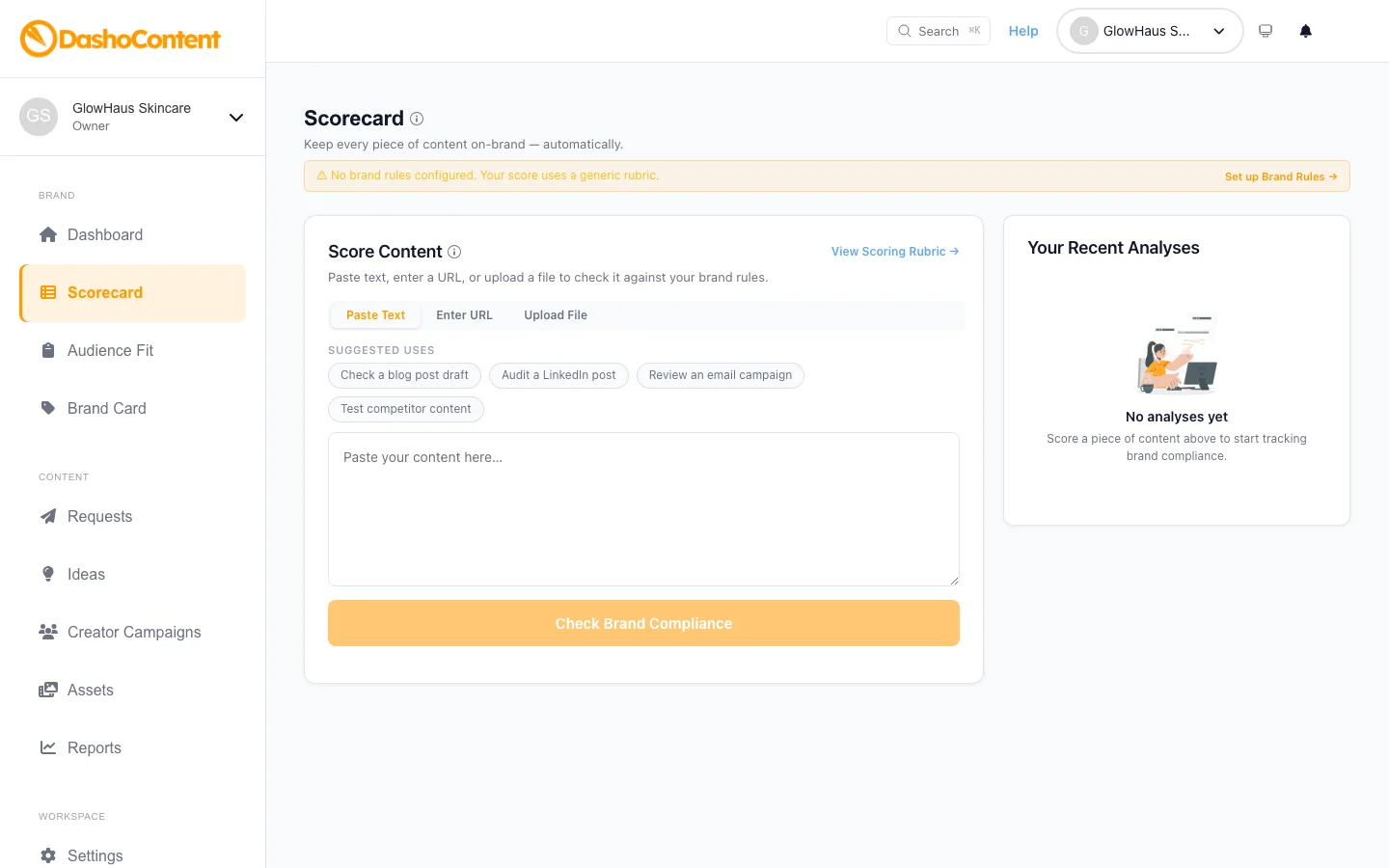
Every draft scored against your brand rules before a person reviews it.
What brand compliance software does
Brand compliance software checks that content follows your brand and policy rules before it goes out. As a team grows, more people write: staff, agencies, freelancers, and creators. Each one has a slightly different read on the brand, and nobody has time to review every piece by hand. The result is drift. Copy goes off-tone, a claim slips through without support, a disclosure gets dropped.
The software fixes this by making the rules active instead of aspirational. The rules live in one place, every draft is measured against them automatically, and problems surface before a human spends time editing. This is the enforcement layer of brand governance: it does not replace your writers or your judgment, it makes sure the standard is applied to everything, every time. Frontify, in its guide to brand governance, frames the same idea: consistency at scale needs a system, not vigilance from one person.
In our 2026 interviews with marketing leaders, nearly every team relied on a single approver, and most caught off-brand content only after it had already published. Software closes that gap by moving the check earlier and applying it to all content, not the subset one reviewer can reach.
One reviewer reads what they can reach. Off-brand tone, unsupported claims, and dropped disclosures slip through as volume grows.
Rules live in one place and every draft is scored automatically, so the standard applies to all content, every time.
What to look for in brand compliance software
Five things separate real compliance software from a shared style doc. Use this as your shortlist when you evaluate tools.
-
Documented brand rules
Voice, tone, claims, and disclosure rules written down in one place, not scattered across PDFs and people’s heads.
-
Automated pre-publish checking
Every draft checked against the rules before a human spends time on it, so off-brand copy is caught early.
-
Approvals with clear ownership
A defined path from brief to sign-off so nothing ships without the right person seeing it.
-
A full audit trail
A record of what was checked, changed, and approved, for accountability and for regulated categories.
-
Multi-brand support
Separate rules per brand, market, or client, without them bleeding into each other.
Every checklist item, mapped to a feature
DashoContent is built around this exact list. Here is which part of the platform covers each requirement.
Brand Card
Define each brand once: its voice, tone, and rules become the single source of truth every draft is measured against.
Content Scorecard
Scores each draft against the Brand Card and flags off-brand tone, unsupported claims, or missing disclosures before review.
Governed workspace
Briefs, drafts, and approvals live in one place per brand, so review is a step in the flow, not a scramble across inboxes.
Audit trail
Every score, edit, and approval is logged, so you can answer "who approved this and against which rules" months later.
One workspace per brand
Run many Brand Cards side by side, each with its own rules, so an agency or portfolio team keeps every brand distinct.
See how the parts fit together on the platform overview, or read how DashoContent handles brand compliance end to end.
Who needs brand compliance software
Two groups feel the pain first. Marketing and brand teams running content at volume across markets, product lines, or regions, where one brand lead cannot personally read every social caption, landing page, and creator post. And agencies producing content for many clients at once, where each client has its own rules and off-brand work costs trust and rework.
Content runs at volume across markets, product lines, and regions. One brand lead cannot read every caption, page, and creator post.
Content ships for many clients at once, each with its own rules, where off-brand work costs trust and rework.
The common thread is scale. When content output passes the point where one reviewer can keep up, quality becomes a matter of luck. Regulated categories like beauty, CPG, and health raise the stakes further, because a wrong claim or a missing disclosure carries legal risk that goes beyond looking off-brand. Brand compliance software gives these teams a check that holds no matter how much they produce.
Frequently asked questions
How does brand compliance software work?
You define your brand rules once in a Brand Card, voice, tone, claims, and disclosures. From then on, every draft is scored against that Brand Card by the Content Scorecard before a person reviews it. Off-brand tone, unsupported claims, and missing disclosures are flagged early. Approvals and an audit trail sit around the check, so on-brand becomes a step in the workflow rather than a final gut check.
How is this different from brand guidelines in a PDF?
A PDF is a reference; nobody runs a draft against it line by line. Brand compliance software makes the rules active: it reads each draft and scores it automatically, so the rules are applied to every piece instead of remembered by one reviewer. See the comparison of brand governance vs brand guidelines.
Is it only for regulated industries?
No. Regulated categories like beauty, CPG, and health get the most obvious value because claims and disclosures carry real risk. But any team producing content across many creators, markets, or clients hits the same wall: one person cannot read every draft in time. The software is for anyone whose content volume has outgrown manual review.
How much does brand compliance software cost?
DashoContent has a free workspace to start and paid plans that scale by seats, brands, and volume. You can set up your first Brand Card and score real drafts before you pay. See current plans on the pricing page.
Can we use it alongside our current writers and tools?
Yes. DashoContent governs content whatever produced it, in-house writers, agencies, or creators. It sits over your existing process and scores what comes out of it, so you keep your team and tools and add the compliance check on top.
Put brand compliance on autopilot
Set up your first Brand Card, score a real draft, and see off-brand content flagged before review. Free to start.
Comparing tools? See plans and pricing.