
The brand
governance gap
We spoke with marketing directors, founders, and agency owners across beauty, agencies, food delivery, and education in Southeast Asia. In nearly every conversation, brand compliance rested on a single person, and off-brand content shipped before anyone caught it.

DashoContent (2026). The Brand Governance Gap: What marketing leaders told us about brand compliance in Southeast Asia.
What we heard
- Nearly every team relied on a single approver for all content. Asked how many people approve content, one marketing exec answered: “Just me.”
- Off-brand and non-compliant content shipped before anyone caught it, forcing post-publish takedowns and rework.
- Review was manual and piece by piece — a separate ChatGPT chat per client, spreadsheets, and “Viber thumbs-up” approvals, with no documented brand voice to check against.
- At one brand spanning 300 restaurant locations, content stopped entirely when the one person responsible left.
- Teams as large as 12 people concentrated every content decision in two or three.
- The pattern matches industry data: 81% of companies encounter off-brand content, yet only about 25% consistently enforce the guidelines they have (Lucidpress, State of Brand Consistency, 2019).
- Consistent brand presentation is associated with revenue increases of 23% (Demand Metric & Lucidpress, 2016) to 33% (Lucidpress, 2019).
Guidelines fail in practice, not in theory
Every brand guidelines PDF makes the same silent promise: if we write the rules down, people will follow them. The teams we interviewed had the PDFs. They still shipped off-brand content, pulled posts after regulators or clients flagged them, and watched production stop when one person went on leave or resigned.
We wanted to know why guidelines fail in practice. So across 2026 we recorded discovery and product calls with marketing leaders and agency owners and asked the same questions: Who approves content? What happens when something off-brand slips through? What does your review process actually look like on a Tuesday afternoon? This page reports what they told us, verbatim, and what it means.
Guidelines on one side, published content on the other
Four findings, in their own words
Brand approval depends on a single person
Just me.Marketing executive, skincare brand — asked how many people approve content
In nearly every conversation, keeping content on-brand was not a system. It was one senior person — often the most expensive person on the team — reading every draft as a human quality gate. One 12-person marketing team still routed every piece through two or three people. The approver’s judgment was the brand guideline; the PDF was decoration.
Why it matters: A single-approver model has a hard ceiling. It scales exactly as far as one person’s reading speed, and it turns every vacation, resignation, and busy week into a brand risk.
Off-brand content ships first and gets caught second
Sometimes it's already posted, and then we'll get flagged that this term should not be used. So we have to take that down and then do a lot of revisions.Marketing director, beauty & CPG
Team after team described catching brand or compliance problems after publishing — the most expensive possible moment. The sequence was consistent: a post goes live, someone (a client, a regulator, a distributor) flags a banned term or claim, then a takedown, an apology, and rework. In regulated categories like beauty, “off-brand” is often also “non-compliant,” and the takedown is not optional.
Why it matters: Review that happens after publishing is not governance. It is damage control with a publishing schedule.
The status quo is manual review, tool sprawl, and no source of truth
It's very manual that we have to check each one, one by one.Marketing director, beauty & CPG
The teams we spoke with reviewed content manually, item by item. The workaround stack was familiar: a separate ChatGPT conversation per client, social calendars in spreadsheets, briefs in Canva, approvals sent “on Viber and a thumbs up.” Two structural gaps sat underneath the sprawl — no documented brand voice (visual guidelines existed, but nothing written for tone, claims, or banned terms), and no audit trail (nobody could answer who approved this, against what standard, when).
Why it matters: Guidelines that live in a PDF are documentation. Guidelines that every draft is checked against are governance. Almost nobody we spoke with had the second thing.
When the one person leaves, content stops
Right now, it's been a complete stop.Operator, 300-restaurant food-delivery brand
The failure mode of governance-by-headcount is not slower content. It is zero content. At one food-delivery brand spanning 300 restaurant locations, the departure of the single person who held the brand in their head halted publishing entirely.
Why it matters: If your brand standard exists only in one person’s judgment, you don’t have a brand standard. You have a dependency.
The interview pattern has a price tag in the wider research. Consistent brand presentation is associated with an average 23% revenue increase (Demand Metric & Lucidpress benchmark, 2016) and up to 33% in the 2019 follow-up (Lucidpress). 68% of companies credit brand consistency with 10–20% of revenue growth (Lucidpress, 2021). Against that upside: 81% still encounter off-brand content, and only ~25% enforce the guidelines they already paid to create. As Frontify defines it, brand governance is the system that keeps a brand consistent as more people create content. Every team we interviewed had the rules. Almost none had the system.
In Southeast Asia, off-brand is also off-side
For beauty and CPG brands in the region, a stray creator caption can break two rulebooks at once.
Product claims. Under the ASEAN Cosmetic Directive — enforced by the Philippine FDA and Singapore's Health Sciences Authority — a cosmetic cannot claim to treat or prevent disease or change a physiological process (“reverses hair loss,” “cures acne”), and every claim must be substantiated under the ASEAN Cosmetic Claims Guidelines. A line like “glass skin overnight” is exactly what gets flagged.
Disclosure. The Philippines' Ad Standards Council and Singapore's ASAS both require creators to disclose material connections — payment, free product, commission — with a tag like #ad or #sponsored visible without expanding the post. A missing disclosure is a violation, not a style choice.
This is why the takedown loop in Finding 2 costs so much: the flagged term is often a regulatory breach, caught only after it is public. (General information on the regulatory landscape, not legal advice.)
How the research was done
Sample. Recorded discovery and product calls held across 2026 with marketing directors, marketing executives, founders, and agency owners across beauty, marketing agencies, food and food delivery, and education.
Markets. Philippines, Singapore, and regional Southeast Asian teams.
Method. This is qualitative research. Calls were recorded with consent and covered current content workflows, approval structures, brand documentation, and incidents of off-brand or non-compliant content. We reviewed the recordings and grouped what we heard into recurring themes; the four findings above are the themes that came up again and again. Every quote on this page is verbatim from a recorded call; identifying details have been removed.
Limitations. This is a qualitative read of a small, purposive sample, not a survey. Participants were prospective or current DashoContent customers, which likely over-represents teams already feeling content-operations pain. We report recurring themes and direct quotes, not percentages, because the sample is too small to quantify honestly. We publish it because the pattern was consistent across every industry and company size we spoke with, and because it lines up with independent survey data (Lucidpress, 2019) collected at much larger scale.
Brand governance, answered
What is the brand governance gap?
The brand governance gap is the distance between having brand guidelines and enforcing them. Most organizations have documented guidelines, but only about 25% consistently enforce them (Lucidpress, 2019) — so off-brand content ships anyway. In our 2026 conversations with marketing leaders and agency owners, enforcement almost always depended on a single human approver.
What is brand governance?
Brand governance is the system of rules, workflows, and checks that keeps content on-brand as more people create it — covering who sets the standard, how every draft is checked against it, and who approves what. Read the full guide →
Why do brand guidelines fail?
Guidelines fail when there is no enforcement layer: no documented voice rules to check drafts against, no review step before publishing, and no audit trail of who approved what. In practice, enforcement collapses into one senior person reading everything — which stops working the moment volume grows or that person leaves.
What does off-brand content cost?
Directly: takedowns, rework, and — in regulated categories like cosmetics — potential regulatory violations under rules like the ASEAN Cosmetic Directive. Indirectly: consistent brand presentation is associated with 23–33% higher revenue (Demand Metric & Lucidpress), which inconsistent brands leave on the table.
How do you fix a single-approver bottleneck?
Move the standard out of the approver’s head: document the brand voice and claim rules, check every draft against them before review, and keep an audit trail. The approver then handles exceptions instead of reading everything.
“On-brand” was a feeling held in one person's head
That works at low volume and breaks the moment content scales across creators, SKUs, locations, or markets. The teams we interviewed did not need more content. They needed every piece checked against a documented standard before it shipped — without one person reading all of it.
That is the gap brand governance closes: define the brand once, score every draft against it, catch off-brand before it goes live.
What is brand governance? →Get glass skin overnight with the #1 hack derms don't want you to know 🔥
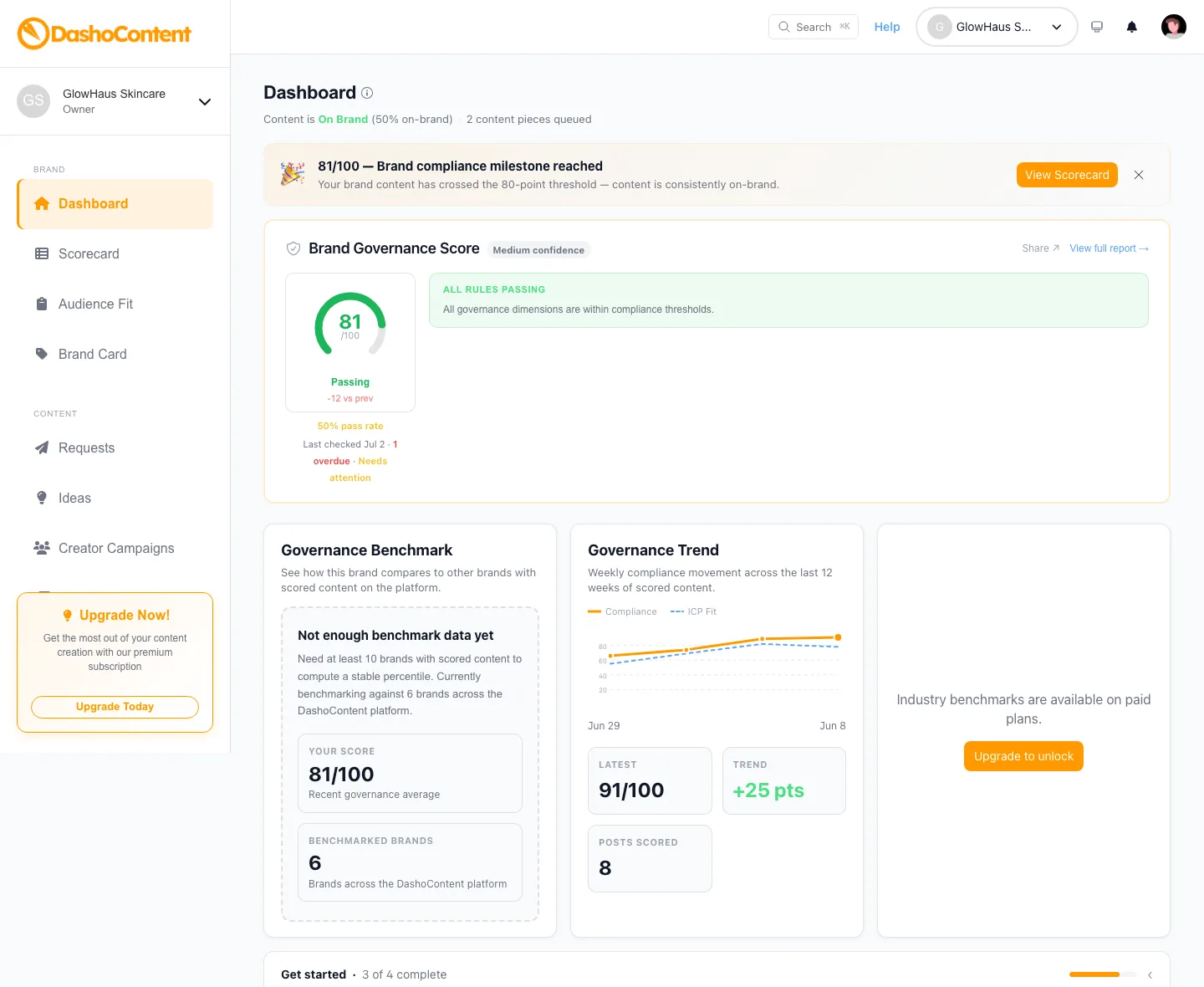
Governance made measurable — a Brand Governance Score against your own rules, so “on-brand” stops being one person's opinion.
Close the gap
Scan your brand free, or see how DashoContent keeps every draft on-brand before it ships.