
Brand Governance for CPG Companies
One brand standard across every SKU, market, and channel. Score all content against your Brand Card so consistency holds as you scale.
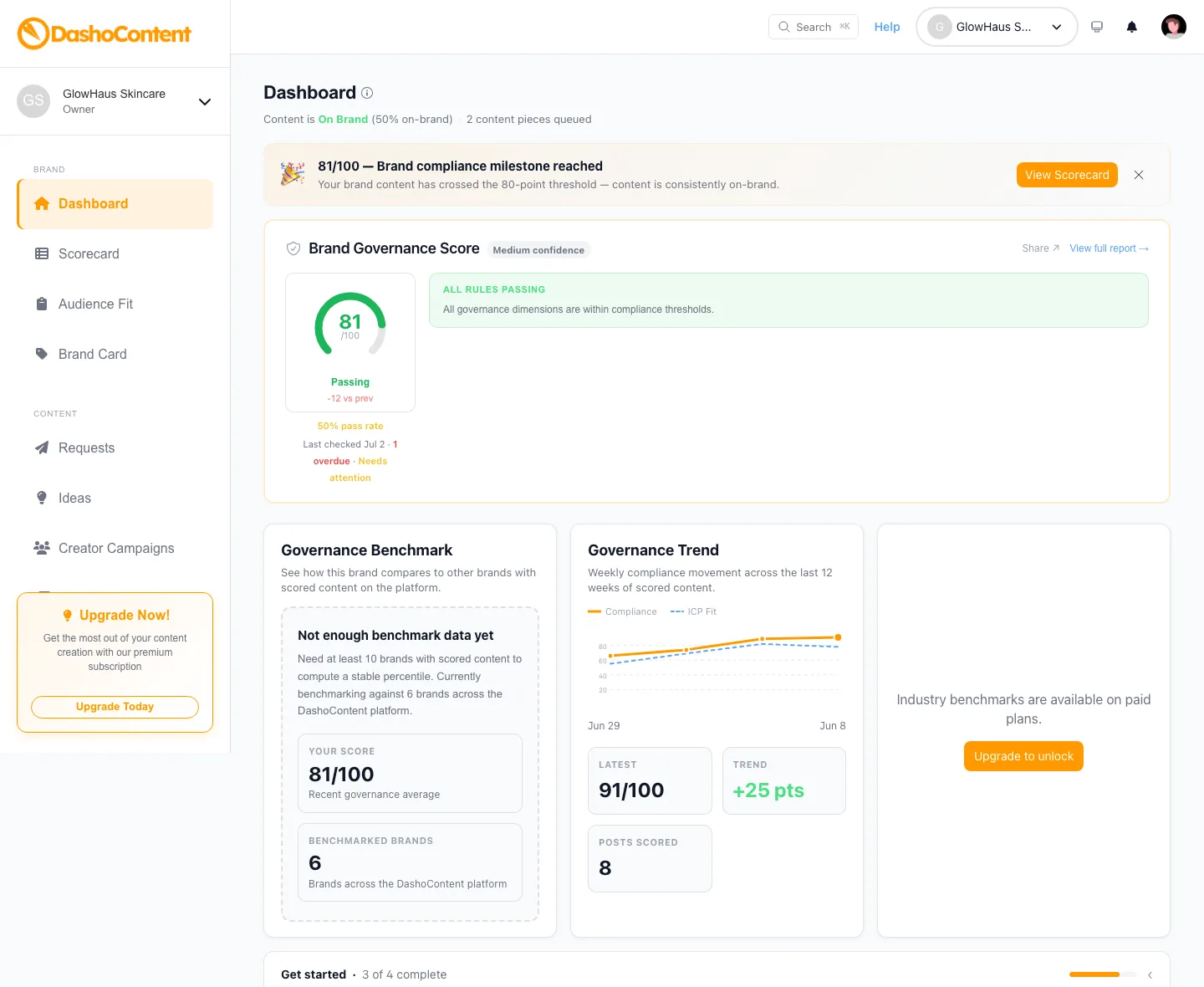
Brand governance for CPG companies gives you a way to keep every SKU, sub-brand, market, and retail channel on-brand before content goes live. DashoContent does that by scoring each draft against your own Brand Card and Content Scorecard, so review starts with rule checks already done instead of relying on one person to catch everything.
Why CPG brands lose consistency
CPG content breaks in predictable places. One parent company can manage dozens of brands, hundreds of SKUs, and multiple markets. Add retailer pages, paid social, email, PDP copy, packaging support, and agency output, and small rule misses stack up fast.
Most teams already have guidelines. The problem is enforcement. Tone, claims language, naming rules, prohibited phrasing, and proof points live in decks and PDFs, but day-to-day review still depends on one brand lead reading everything. That does not hold once volume climbs.
Governance that uses your actual rules
DashoContent turns your guidelines into working controls. Each brand gets its own governed workspace with a Brand Card that captures the rules that matter in practice: voice, positioning, approved claims, required language, audience, product context, and market-specific notes.
Then every draft is checked against a Content Scorecard before a human reviews it. You see how closely the copy matches your standards, where it drifted, and what needs to change. That means reviewers spend less time policing basics and more time making judgment calls.
Built for multi-brand and multi-market teams
CPG companies rarely have one brand system. Personal care, food, and household lines each carry different promises, vocabularies, and compliance needs. A single generic prompt or shared writing tool blurs those differences. Governance has to be brand-specific from the start.
- One governed workspace per brand
- Brand Cards tailored to each sub-brand and product line
- Scorecards that reflect channel, market, and approval rules
- Consistent review across internal teams, agencies, and retail partners
That structure matters when the same company is shipping copy for a value detergent, a premium skincare line, and a snack launch across different regions. Each team moves faster when the guardrails are already in the workflow.
Scale content without losing control
More output should not mean more drift. With governance built into drafting and review, your team can scale campaign assets, product detail pages, retailer copy, and localized variations without sending every item through the same bottleneck.
That control has real business value. Consistent brand presentation is estimated to lift revenue by up to 23%. For CPG teams, consistency is not a cosmetic issue. It affects shelf recognition, retailer execution, repeat purchase, and trust across markets.
What changes for your team
Instead of asking reviewers to remember every rule, you give them a system that applies those rules first. Instead of chasing guideline documents, teams work from a live brand standard. Instead of debating whether copy feels on-brand, you review a draft with a visible score against agreed criteria.
This is how brand governance for CPG companies becomes operational. The rules you already wrote start showing up in the actual work, at the point where content is created and approved.
Can DashoContent handle multiple sub-brands with different rules?
Yes. Each sub-brand can have its own Brand Card, Content Scorecard, and governed workspace, so a household cleaner does not inherit the voice or claims rules of a baby care line.
Does this replace human brand review?
No. It improves it. Every draft is scored against your brand rules before review, so humans spend less time catching preventable issues and more time approving judgment, nuance, and market context.
How is this different from a generic AI writing tool?
Generic tools generate text. DashoContent governs it. The key difference is that drafts are checked against your own Brand Card and Content Scorecard before a human sees them, which gives you a repeatable way to enforce guidelines at scale.
The same system runs underneath everything
Brand Card
Voice, tone, and rules defined once per brand — the source of truth every draft is measured against.
Content Scorecard
Every draft scored for brand compliance before a human reviews it — catch drift before it ships.
Governed workspaces
One workspace per brand: briefs, drafts, assets, and approvals in a single tracked place.
Approvals that move
A defined brief → draft → review → approve flow, so sign-off takes minutes, not days.
Have us run it for you
Done-for-you content operations, governed against your Brand Card.
Explore Managed Services →Run it yourself
Self-serve governed workspaces for agencies and lean teams.
Explore the platform →Keep every brand on-message
Start free and run it yourself, or have us run it for you.