
What Is Content Governance?
Content governance is the system of rules and checks that keeps every piece of content on-brand and compliant as more people create it.
Content governance is the set of rules, workflows, and checks that keep content on-brand, accurate, and compliant as more people produce it. It defines what good looks like, how drafts are reviewed, who approves them, and what record is kept after publish.
The practical definition
If you are asking what is content governance, think operating system, not style preference. It is the structure behind content quality. It sets standards for voice, claims, legal language, formatting, approvals, and exceptions.
A team can publish without content governance. It just cannot do it consistently at scale. Once you have multiple writers, agencies, markets, or channels, informal review breaks down and risk goes up.
What content governance includes
At a minimum, content governance includes documented guidelines, a review process, and an audit trail. In practice, strong programs also define owners, escalation paths, and measurable pass or fail criteria before a human approver signs off.
- Guidelines: voice, terminology, claims rules, required disclosures, channel standards, and banned language.
- Scoring and approval checks: a draft is assessed against brand rules before review, then approved, revised, or rejected.
- Audit trail: who changed what, who approved it, when it was published, and which rules were applied.
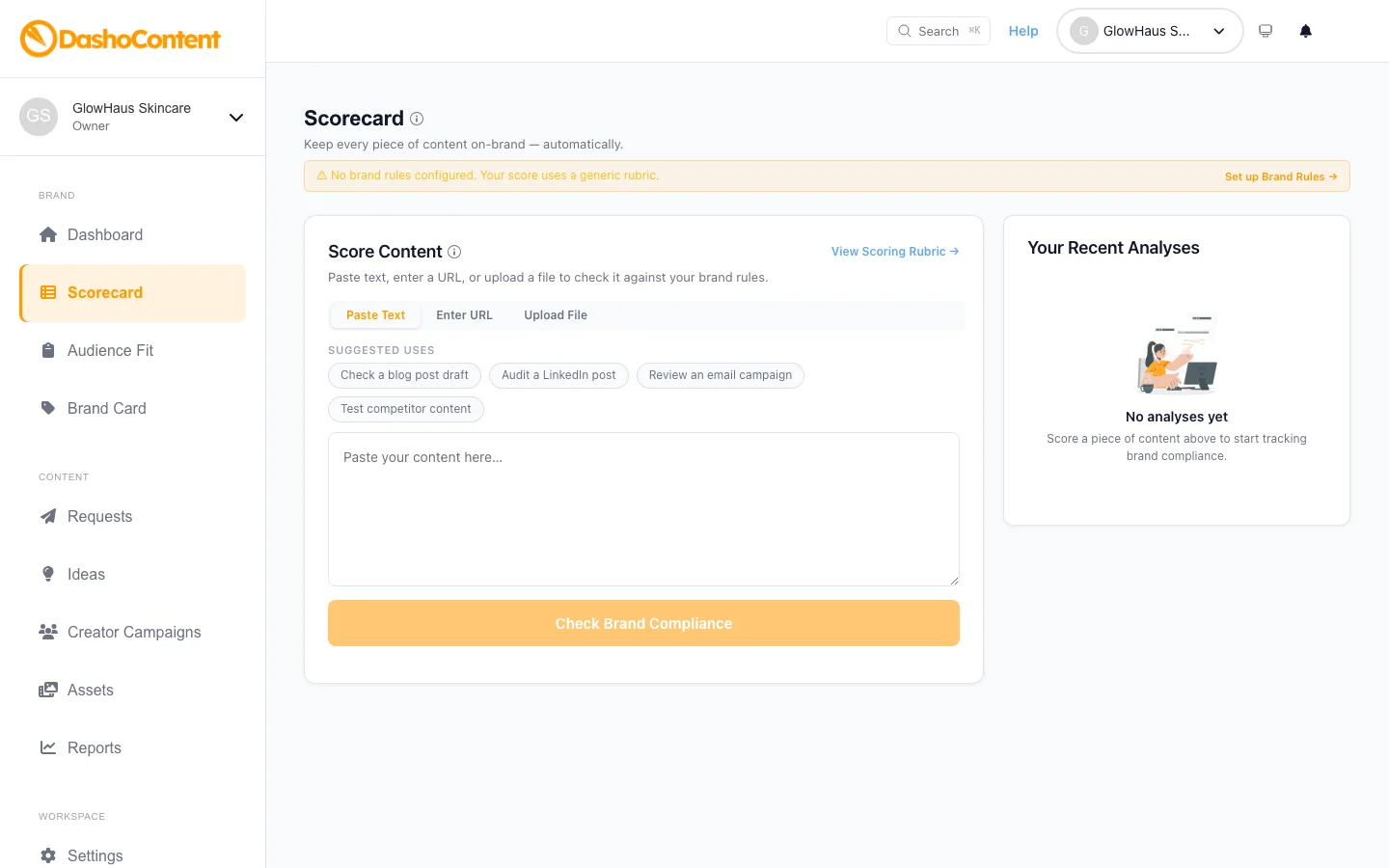
DashoContent treats this as a governance problem first. Each draft is scored against a Brand Card and Content Scorecard before a human reviews it. That gives teams a repeatable checkpoint tied to their own standards, not generic writing advice.
How it relates to brand governance
Brand governance sets the broader rules for how your brand shows up across content, design, legal review, and customer touchpoints. Content governance is the part focused on words and publishing workflows.
In other words, brand governance defines the standard. Content governance applies that standard to briefs, drafts, approvals, and published assets. If brand governance is the policy layer, content governance is the execution layer.
Why it matters as teams scale
The cost of weak governance grows with volume. A five-person team can catch issues in Slack. A team shipping 50 articles, emails, landing pages, and social posts a week cannot rely on memory and goodwill.
Without clear governance, you get off-brand copy, inconsistent claims, longer review cycles, and avoidable compliance risk. You also lose speed because every draft turns into a fresh debate about tone, wording, and approval authority.
Who owns content governance
Ownership usually sits with brand, content operations, or marketing operations, with legal and compliance as required reviewers in regulated cases. The exact org chart varies. The key is one accountable owner for standards, workflow, and enforcement.
That owner should maintain the rules, update them as products or regulations change, and track adherence over time. Contributors still write. Editors still edit. Governance creates the shared system they work inside.
What good content governance looks like
Good content governance is clear enough that two reviewers reach similar conclusions on the same draft. It reduces subjective back-and-forth. It makes approvals faster because reviewers are checking against agreed rules, not personal taste.
It should also be traceable. If a claim is challenged or a page needs updating, you should be able to see the source, review history, and final approver. That record matters for learning, accountability, and compliance.
Is content governance the same as editorial guidelines?
No. Editorial guidelines are one input. Content governance also covers workflow, approval rights, scoring checks, exceptions, and the audit trail after content is published.
Who should approve content under a governance model?
The approver depends on risk and channel, but there should be a named owner and a defined path. Low-risk content may need brand or editorial review. Higher-risk content may also require legal, compliance, or product approval.
The same system runs underneath everything
Brand Card
Voice, tone, and rules defined once per brand — the source of truth every draft is measured against.
Content Scorecard
Every draft scored for brand compliance before a human reviews it — catch drift before it ships.
Governed workspaces
One workspace per brand: briefs, drafts, assets, and approvals in a single tracked place.
Approvals that move
A defined brief → draft → review → approve flow, so sign-off takes minutes, not days.
Have us run it for you
Done-for-you content operations, governed against your Brand Card.
Explore Managed Services →Run it yourself
Self-serve governed workspaces for agencies and lean teams.
Explore the platform →Keep every brand on-message
Start free and run it yourself, or have us run it for you.