
How to Keep Social Content On-Brand at Scale
A repeatable way to keep every social post on-brand across creators and channels — scored against your brand rules before it goes live.
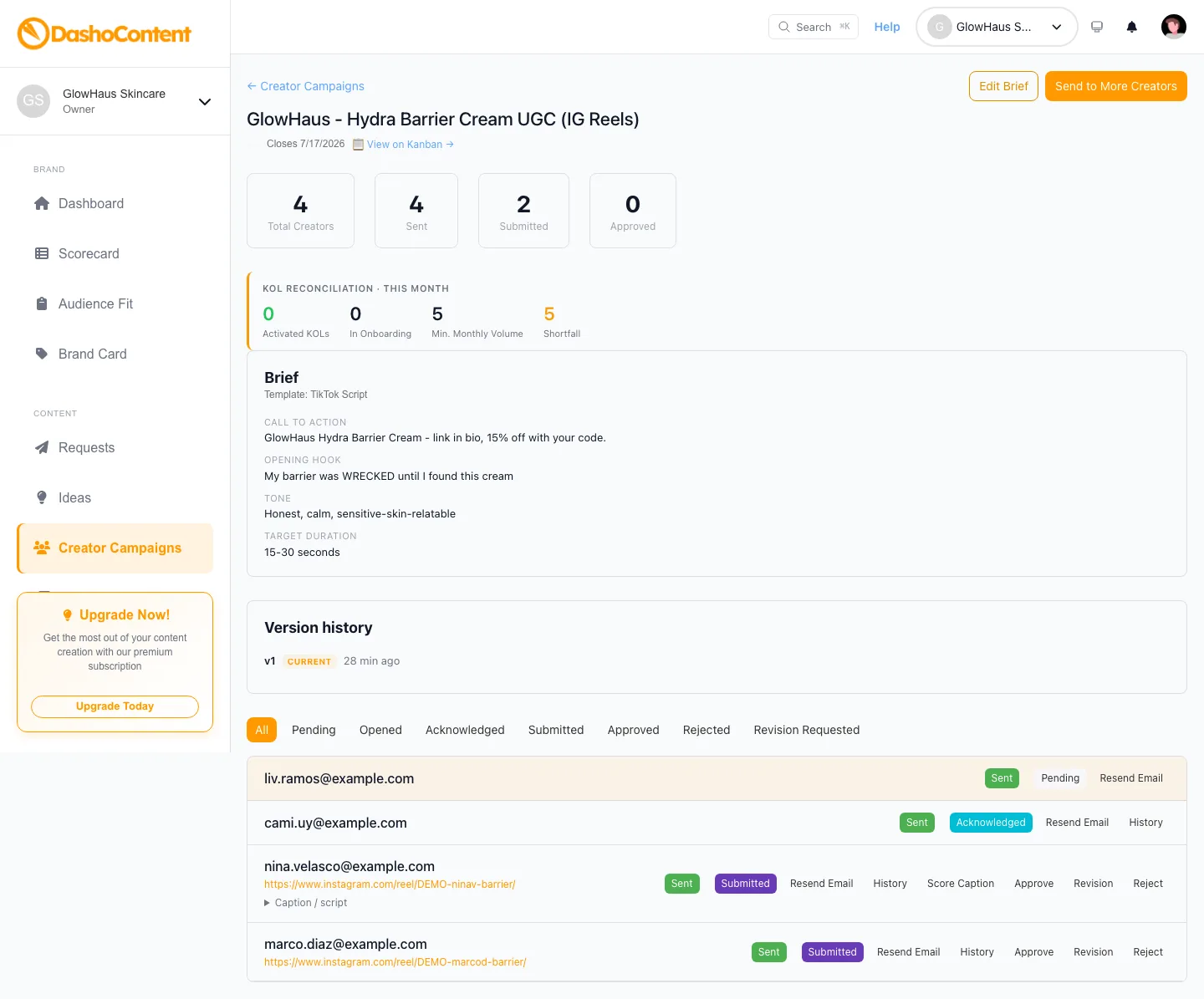
To keep social media content on-brand at scale, you need to turn brand judgment into a repeatable check. Define your brand rules once in a Brand Card, score every draft against a Content Scorecard, then send only scored drafts to human review. That keeps volume up without letting brand drift slide through.
Why manual review breaks under volume
Most teams start with one or two people who can feel when a post is off. That works at 10 posts a week. It breaks at 100, across TikTok, Instagram, LinkedIn, paid social, and creator content.
The problem is not effort. It is consistency. When brand lives in one person's head, reviews get slower, comments get subjective, and edge cases pile up. Two reviewers can give different feedback on the same draft. Over time, your feed starts sounding like whoever wrote fastest.
Make the brand check automatic
If you want to know how to keep social media content on-brand at scale, start by making the first check automatic. A draft should be measured against your rules before a human spends time on it. That gives your team a shared standard from the first pass.
DashoContent does this with two controls. The Brand Card captures what your brand says, avoids, and sounds like. The Content Scorecard checks each draft against those rules. Reviewers see where a post passes, where it misses, and what needs work before approval.
What goes in the Brand Card
A useful Brand Card is specific. It should cover voice, claims, audience fit, banned phrases, product naming, legal or regulatory constraints, and channel differences. If your LinkedIn posts can name customer pain directly but your TikTok captions need a lighter tone, write that down.
- Voice rules: plainspoken, technical, playful, formal, direct
- Hard constraints: claims, disclaimers, legal terms, competitor references
- Channel rules: post length, CTA style, emoji use, creator disclosures
- Content boundaries: topics to avoid, proof standards, sensitivity issues
How the Content Scorecard keeps reviews consistent
The Scorecard turns taste into criteria. Instead of vague notes like "doesn't feel like us," you review against defined checks. That helps in-house teams, agencies, and freelancers work from the same playbook.
Scores also make triage easier. High-scoring drafts move faster. Low-scoring drafts get fixed before they hit a senior reviewer. That reduces back-and-forth and gives you a way to explain approvals with something stronger than opinion.
Bring creators in without adding friction
Creator content adds reach, but it also adds variance. If every partner has to learn your brand from scattered docs and Slack threads, quality will swing. You need a way to give guidance early without turning onboarding into a project.
The practical move is to share the rules and scoring path without requiring every creator to sign up for another tool. Give them a clear brief, let their draft get scored against your Brand Card, and route revisions from the score. They get specific direction. You get content that is closer to usable on the first review.
Measure brand compliance instead of guessing
If you cannot measure compliance, you cannot improve it. Track score trends by channel, campaign, creator, and team. Look at first-pass score, approval rate, revision count, and time to approve. Those numbers show where your rules are clear and where they are not.
This matters because scale creates drift slowly. One off-tone caption is noise. Fifty in a month is a pattern. When every draft is scored the same way, you can spot that pattern early and fix the rule, the brief, or the source of the content.
What is the best way to keep creator posts on-brand without slowing them down?
Give creators a short brand brief tied to your Brand Card, then score each draft before human review. They get concrete feedback fast, and your team avoids rewriting from scratch.
How do you measure whether social content is actually on-brand at scale?
Track draft scores, first-pass approval rate, revision rounds, and approval time by channel and contributor. If scores rise and revisions drop, your brand system is getting clearer and your output is holding its shape.
The same system runs underneath everything
Brand Card
Voice, tone, and rules defined once per brand — the source of truth every draft is measured against.
Content Scorecard
Every draft scored for brand compliance before a human reviews it — catch drift before it ships.
Governed workspaces
One workspace per brand: briefs, drafts, assets, and approvals in a single tracked place.
Approvals that move
A defined brief → draft → review → approve flow, so sign-off takes minutes, not days.
Have us run it for you
Done-for-you content operations, governed against your Brand Card.
Explore Managed Services →Run it yourself
Self-serve governed workspaces for agencies and lean teams.
Explore the platform →Keep every brand on-message
Start free and run it yourself, or have us run it for you.