
Brand Governance vs Brand Management
Brand management organizes your brand's assets and guidelines. Brand governance enforces them — scoring every draft against your rules before it ships.
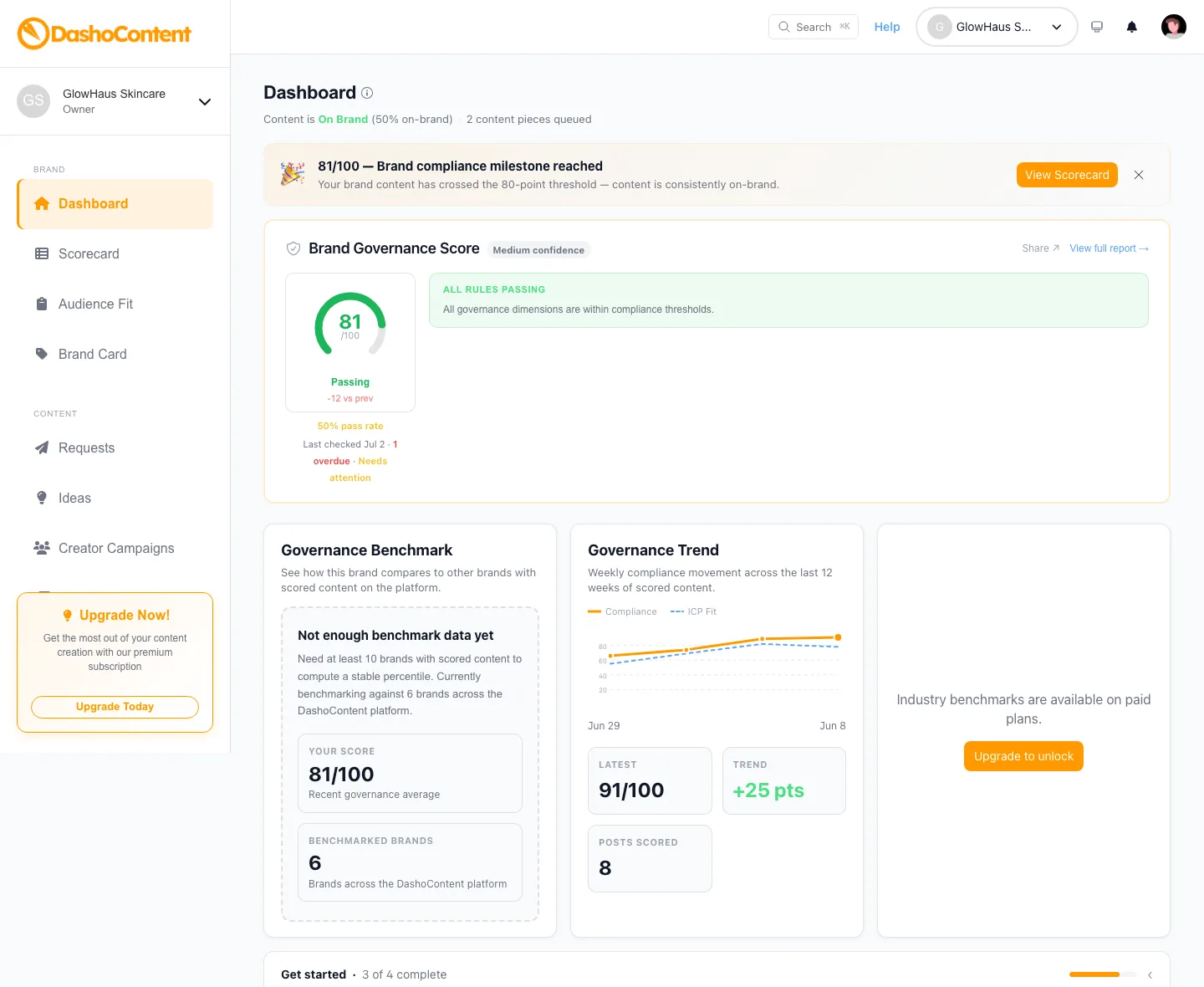
Brand management organizes your brand system. It stores assets, templates, and guidelines so teams know what to use. Brand governance checks the content itself. It scores each draft against your brand rules before review, so you can catch off-brand claims, tone, and messaging before anything ships.
What brand management does
Brand management is the operational layer around brand assets and standards. It helps your team find the right logo, the current deck template, the approved product screenshot, and the latest messaging guide.
In practice, this usually means DAM, template control, and guideline hosting. Tools in this category help with version control, permissions, asset distribution, and keeping one source of truth. That matters. If people cannot find the right files, they will use the wrong ones.
What brand governance adds
Brand governance deals with the output, not only the inputs. It asks a different question: does this draft follow the brand standard right now, in this actual piece of content?
That means checking tone, required messages, banned phrases, claim language, audience fit, and structural rules on every draft before human review. At DashoContent, those rules live in a Brand Card and Content Scorecard. Each draft is scored against your rules before an editor or brand lead steps in.
Brand governance vs brand management side by side
- Brand management: stores assets, publishes guidelines, controls templates, manages access.
- Brand governance: evaluates drafts, enforces rules, flags misses, creates a review standard.
- Brand management: helps teams start from the right materials.
- Brand governance: helps teams finish with on-brand content.
- Brand management: strongest for logos, imagery, layouts, and reference docs.
- Brand governance: strongest for messaging, tone, claims, and content quality control.
That is the practical answer to brand governance vs brand management. One distributes the standard. The other applies the standard to real work before publication.
Why guidelines alone break at volume
A 40-page guideline deck does not review a draft. A DAM does not tell you whether a landing page sounds like your brand. Templates help with structure, but they do not catch weak proof points, risky claims, or language your team banned six months ago.
This gap gets bigger as content volume rises. More channels. More contributors. More freelance writers. More AI-assisted drafting. When 20 or 200 drafts move each month, manual checking becomes inconsistent. Teams skip steps. Reviewers rely on memory. Off-brand content gets through.
Why teams need both
Brand management and brand governance solve different problems. Most serious teams need both. You still need approved assets, current templates, and a clean place to host guidelines. Governance does not replace that foundation.
But if your goal is consistency across actual content, management alone is incomplete. Governance gives reviewers a shared scoring method and gives creators feedback before final review. That can reduce back-and-forth, shorten review cycles, and make approval less subjective.
Where each category fits
If your main issue is asset sprawl, outdated logos, or teams using old templates, brand management should come first. This is where platforms like Frontify, Bynder, and Marq are strong. They help you organize and distribute the brand system.
If your issue is that published content keeps drifting off-message even though the guidelines exist, you need governance. DashoContent is built for that layer. It scores drafts against your own rules before human review, so enforcement happens on the work itself.
Is brand governance the same as brand management?
No. Brand management handles assets, templates, and guidelines. Brand governance checks whether each piece of content follows those rules before it goes live.
Can a DAM or guideline portal solve brand consistency on its own?
It helps, but only up to a point. Those systems make standards available. They do not inspect each draft for tone, messaging, claims, or required brand language.
When does a team usually need brand governance?
Usually when content volume grows and review gets inconsistent. Common signs are repeated rewrites, subjective approvals, off-brand AI drafts, and too many contributors across teams or agencies.
The same system runs underneath everything
Brand Card
Voice, tone, and rules defined once per brand — the source of truth every draft is measured against.
Content Scorecard
Every draft scored for brand compliance before a human reviews it — catch drift before it ships.
Governed workspaces
One workspace per brand: briefs, drafts, assets, and approvals in a single tracked place.
Approvals that move
A defined brief → draft → review → approve flow, so sign-off takes minutes, not days.
Have us run it for you
Done-for-you content operations, governed against your Brand Card.
Explore Managed Services →Run it yourself
Self-serve governed workspaces for agencies and lean teams.
Explore the platform →Keep every brand on-message
Start free and run it yourself, or have us run it for you.