
What Is a Brand Governance Platform?
A brand governance platform enforces your brand rules on every piece of content — scoring each draft against one brand standard before it ships.
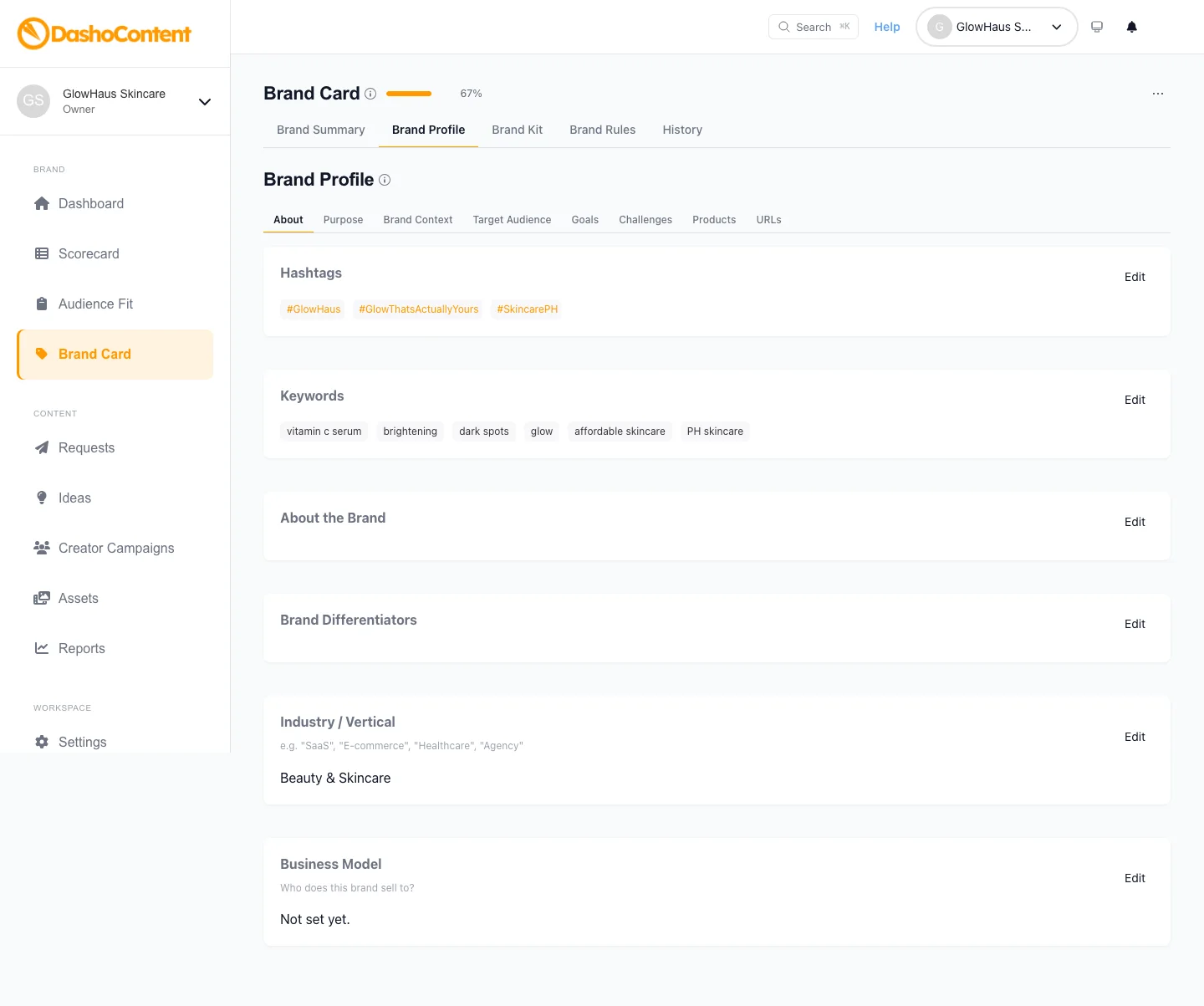
A brand governance platform is software that codifies your brand once, then checks every draft against that standard before a human reviews it. It turns voice, tone, claims, terminology, and approval rules into a working system, so on-brand content becomes the default as output grows across teams, creators, and markets.
What a brand governance platform does
At a basic level, a brand governance platform stores the rules that define your brand and applies them to content in production. Those rules usually cover voice, tone, required phrases, banned phrases, product naming, claim boundaries, disclaimers, audience rules, and channel-specific guidance.
In DashoContent, that standard lives in a Brand Card and a Content Scorecard. The Brand Card captures how your brand should sound and what it can or cannot say. The Scorecard checks each draft against those rules before review. The platform also manages approvals and keeps an audit trail of who changed what, who approved it, and why.
How it works step by step
Step 1 is definition. You document the brand once in a structured format, not as a loose PDF. That includes voice traits, tone by channel, legal or regulatory limits, naming rules, approved claims, and examples of good and bad copy.
Step 2 is drafting. A team member, freelancer, or creator produces a draft for a product page, email, paid ad, PDP, retail pitch, or social post. Step 3 is scoring. Before anyone approves it, the platform checks the draft against the Brand Card and returns a content score with flagged issues. Step 4 is human review and approval. Reviewers fix or reject weak sections, approve content that meets the standard, and the system logs the decision.
Why scoring matters
Most brand problems do not come from missing guidelines. They come from guidelines that are hard to apply under deadline. A score gives reviewers a concrete starting point. Instead of asking, "Does this feel on-brand?" they can see where the draft broke specific rules and what needs attention.
That matters when content volume goes up. If one team ships 20 assets a week, manual review may hold. If five markets, ten creators, and three agency partners are all producing copy, drift starts fast. Scoring before review helps catch issues earlier, when edits are cheaper and faster.
How it differs from brand guidelines
Brand guidelines are usually static documents. They explain the brand, but they do not inspect live drafts. A PDF can tell you the approved tone for TikTok or the exact way to write an ingredient claim. It cannot stop a bad draft from moving forward.
A brand governance platform turns those guidelines into operational rules. It checks content in context, routes it through approval, and records the outcome. In practice, guidelines are reference material. Governance software is an enforcement layer.
How it differs from an AI writer
An AI writer is mainly a generator. It helps produce drafts from prompts. A brand governance platform is mainly a control system. Its job is to make sure content is measured against your brand's own rules before approval.
Some platforms can assist with drafting, but generation is not the core distinction. The key difference is governance. In DashoContent, every draft is scored against the Brand Card and Content Scorecard before a human signs off. That is different from asking a generic model to "sound like our brand" and hoping for consistency.
Who typically needs one
Brand governance platforms are most useful when many people create content for the same brand. That often includes multi-SKU beauty and CPG teams, regional marketing groups, in-house creative teams, agency partners, retail marketing teams, and creator programs with high monthly output.
- Teams with many products, claims, and naming rules
- Brands running content across paid, owned, retail, and creator channels
- Agencies that need one source of truth across multiple clients or sub-brands
- Organizations where approval speed matters, but brand risk still needs controls
What to look for in a platform
If you are evaluating options, focus on whether the system can turn your brand into rules that are actually checkable. Look for structured brand inputs, pre-review scoring, workflow controls, version history, and clear audit logs.
Also check fit for your operating model. A good platform should support multiple brands or SKUs, separate scorecards by channel or market, and human approval steps that match how your team already works.
Is a brand governance platform the same as a DAM or CMS?
No. A DAM stores assets. A CMS publishes content. A brand governance platform checks whether content follows brand rules and approval requirements before it moves forward.
Can small teams use a brand governance platform?
Yes, but the need is strongest when output is spread across several people or channels. A five-person team with one reviewer can use it. A larger team with agencies, creators, and regional stakeholders usually gets more value.
Does a brand governance platform replace human review?
No. It improves human review by scoring drafts before approval and flagging issues early. Final judgment still belongs to people who know the brand, the channel, and the commercial context.
The same system runs underneath everything
Brand Card
Voice, tone, and rules defined once per brand — the source of truth every draft is measured against.
Content Scorecard
Every draft scored for brand compliance before a human reviews it — catch drift before it ships.
Governed workspaces
One workspace per brand: briefs, drafts, assets, and approvals in a single tracked place.
Approvals that move
A defined brief → draft → review → approve flow, so sign-off takes minutes, not days.
Have us run it for you
Done-for-you content operations, governed against your Brand Card.
Explore Managed Services →Run it yourself
Self-serve governed workspaces for agencies and lean teams.
Explore the platform →Keep every brand on-message
Start free and run it yourself, or have us run it for you.